Skip to content
AI Protection
Free
Start with what’s already out there

We’ll show you your exposure before you pay anything.

Run a free scan

Breaches we’re tracking

All tracked breaches
No letter, but worried?

Enter your email and we’ll tell you which breaches include you.

Check my email

Stay Safe · Louisiana

AI scams in Louisiana: where to get help.

If a call, text, or video has you worried, you’re in the right place. This page lists the official places to get help in Louisiana, what to do first, and simple ways to protect your family.

Scams look different now. AI can copy a voice, make a convincing video, and write a message with your details in it. The help is still the same: stop, check, and report.

Public data

What’s happening in Louisiana

These numbers come from public government reports. They count what people reported, so the real numbers are likely higher. The reports don’t separate AI scams by state, so read them as the bigger picture AI scams are part of.

FTC Consumer Sentinel Network, 2024 data

  • 68,025 fraud and other consumer reports from Louisiana residents.
  • $89.4 million in reported fraud losses.
  • The median fraud loss was $425.
  • 15,991 identity theft reports.
  • Louisiana ranked 9th of 50 states for fraud and other reports per person (1,472 per 100,000 people).
  • Louisiana ranked 8th of 50 states for identity theft reports per person (346 per 100,000 people).

Source: Consumer Sentinel Network Data Book 2024, State page, p. 40; State Rankings, pp. 20–21.

FBI Internet Crime Complaint Center (IC3), 2025 data

  • 8,623 internet crime complaints from Louisiana (31st in the nation).
  • $105,440,238 in reported losses (33rd in the nation).
  • People 60 and older filed 1,906 complaints (32nd in the nation).
  • People 60 and older reported $35,856,847 in losses (37th in the nation).
  • 1,366 complaints involved cryptocurrency (31st in the nation).
  • $53,679,269 in losses involved cryptocurrency (33rd in the nation).

Source: 2025 Internet Crime Report, States by Complaint Count, p. 28; States by Complaint Loss, p. 29; Overall State Statistics for 60+, p. 49; Overall State Statistics for 60+, p. 50; Cryptocurrency Complaints by State, p. 56; Cryptocurrency Losses by State, p. 57.

Nationally: In 2025, the FBI received 22,364 complaints that mentioned AI, with $893,346,472 in reported losses. It was the first year the FBI tracked AI as its own category. Source: 2025 Internet Crime Report, "Artificial Intelligence (AI) Used in Cybercrime," p. 39.

AI scams to watch for

Attackers used to make mistakes. That’s how you knew.

AI scams to watch for

Typos and strange phrasing used to give scams away. AI doesn’t make those mistakes. These are the patterns to know. The details will keep changing. The way to check stays the same.

Phone call

A call that sounds like family

You get a call from a grandchild, a parent, or a friend. They’re scared. There’s been an accident, an arrest, or a hospital bill. They need money now and ask you not to tell anyone. The voice sounds right because AI can copy a voice from a short clip online.

How to check: Hang up and call them back on the number you already have. Ask your family safe word.

Report it: FTC, Department of Justice’s National Elder Fraud Hotline

Make a Family Safe Phrase card

Video

A video that looks real

A video call or clip shows someone you know or trust: a relative, a boss, a celebrity, a news anchor. They ask for money, push an investment, or tell you to act fast. AI can make a face and voice say things the real person never said.

How to check: Contact the person another way. Be wary of any investment you first heard about from a video or an ad.

Report it: FTC, FBI IC3

Text or email

A text or email that knows you

A message uses your name, your bank, a recent order, or a package you’re expecting. It asks you to tap a link, confirm a code, or “verify” your account. AI writes these quickly, without typos, for thousands of people at once.

How to check: Don’t tap the link. Go to the company’s website or app yourself, or call the number on your card or bill.

Report it: FTC, FBI IC3

Impostors

Someone “official”

A caller says they’re from the IRS, Social Security, Medicare, the sheriff’s office, or your bank’s fraud team. They say there’s a warrant, a frozen account, or a problem only payment will fix. Real agencies don’t demand gift cards, crypto, or wire transfers, and they don’t threaten arrest over the phone.

How to check: Hang up and call the agency at the number on its official website.

Report it: Social Security OIG, FTC

Online

A new friend or romance online

Someone you met online is kind, attentive, and always available. Over weeks, the talk turns to money, a crypto opportunity, or an emergency. AI can keep many of these conversations going at once.

How to check: Never send money to someone you haven’t met in person. Talk it over with someone you trust.

Report it: FTC, FBI IC3

Computer or phone

A fake “tech support” or account alert

A pop-up, call, or message says your computer is infected or your account was hacked. They ask for remote access or tell you to move money to “keep it safe.”

How to check: Close the window or hang up. No real company asks you to move your money to protect it.

Report it: FTC, FBI IC3

If it happened to you

What to do if it happens to you

You did nothing wrong by being targeted. These steps work in any order, but the first two are the most urgent.

  1. Stop contact. Hang up, stop replying, and don’t send more money. Don’t click links or install anything they ask you to.

  2. Call your bank or card company. Use the number on the back of your card. Tell them it was fraud and ask them to stop or reverse the payment. If you paid with a gift card, call the company that issued it. If you sent crypto, contact the exchange you used.

  3. Report it to the FTC at ReportFraud.ftc.gov. Your report helps law enforcement spot patterns.

  4. If someone used your personal information, go to IdentityTheft.gov. The FTC will give you a personal plan with the next steps for your situation.

  5. If it happened online, by text, or by phone and you lost money, file a complaint with the FBI at ic3.gov.

  6. Contact the Louisiana Attorney General. Call 1-800-351-4889 or file a complaint online. Your state’s consumer protection office tracks scams aimed at Louisiana residents.

  7. File a report with your local police or sheriff. Ask for a copy. Banks and creditors may ask for it.

  8. Freeze your credit at all three bureaus. It’s free, and it stops new credit from being opened in your name until you lift it.Equifax: equifax.com
    Experian: experian.com
    TransUnion: transunion.com

If you’re 60 or older, or helping someone who is, the Department of Justice’s National Elder Fraud Hotline can walk you through these steps: 1-833-FRAUD-11 (1-833-372-8311). This matters in Louisiana: people 60 and older here reported $35,856,847 in internet crime losses in 2025 (37th in the nation).

Watch for “recovery” scams. Be careful of anyone who contacts you offering to get your money back for a fee. That is a common second scam. Government agencies don’t charge to help you.

Official help

Where to get help in Louisiana

Official Louisiana offices first, then the federal services that work in every state. Numbers and links were checked on each agency’s own website.

Attorney general

Older adults and caregivers

Governor's Office of Elderly Affairs (GOEA) - Elderly Protective Services (EPS)

Report abuse or financial exploitation

Report suspected abuse, neglect or financial exploitation of an older or vulnerable adult.

U.S. Department of Justice

National Elder Fraud Hotline

Case managers help people 60 and older, and their families, report fraud and find next steps. Monday to Friday, 10 a.m. to 6 p.m. Eastern.

National resources

Report a scam or identity theft

FBI

Internet Crime Complaint Center (IC3)

Report online and cyber-enabled fraud to the FBI, including investment, cryptocurrency, romance, and fake-text scams.

Consumer Financial Protection Bureau (CFPB)

Submit a complaint to the CFPB

If a bank, card company, or money-transfer service will not help with a problem, file a complaint. The CFPB sends it to the company and tracks the response.

Older adults, Social Security and Medicare

Social Security Administration, Office of the Inspector General

Report Social Security scams

Report calls, texts, emails, or letters from people pretending to be Social Security. To check on your benefits, call Social Security at 1-800-772-1213.

Centers for Medicare & Medicaid Services

1-800-MEDICARE

Report suspected Medicare fraud, like charges for services you did not get, or someone asking for your Medicare number.

Freeze your credit (free)

Contact each bureau separately. A freeze is free, doesn’t affect your credit score, and can be lifted when you need to apply for credit.

Before anything happens

Protect your family

The best protection is a few habits your family agrees on before anything happens.

  • Pick a family safe word.

    Choose a word or question only your family knows. Anyone who calls in an “emergency” has to know it. Don’t post it or text it.

  • Call back on a number you already have.

    If a call, text, or video asks for money or information, hang up and reach the person or company yourself.

  • Slow down when it feels urgent.

    Pressure to act right now, keep it secret, or pay in an unusual way is the clearest sign of a scam.

  • Lock down what’s public.

    Set social accounts to private. Think twice before posting travel plans, birthdays, your kids’ schools, or videos with your voice. Scams that sound personal are built from personal details.

  • Turn on two-step verification

    for email, banking, and phone accounts. Never share the codes with anyone who calls you.

  • Talk to the people most likely to get the call.

    Parents, grandparents, and teenagers. A five-minute conversation is worth more than any warning.

  • Freeze your credit now.

    You don’t have to wait for a problem. It’s free and you can lift it anytime.

Free posters

Free posters to print and share

For your family, a senior center, library, community center, place of worship, clinic, school, or apartment building. Each is one U.S. Letter page, free to copy and share. The first poster is made for Louisiana: it lists your attorney general’s number.
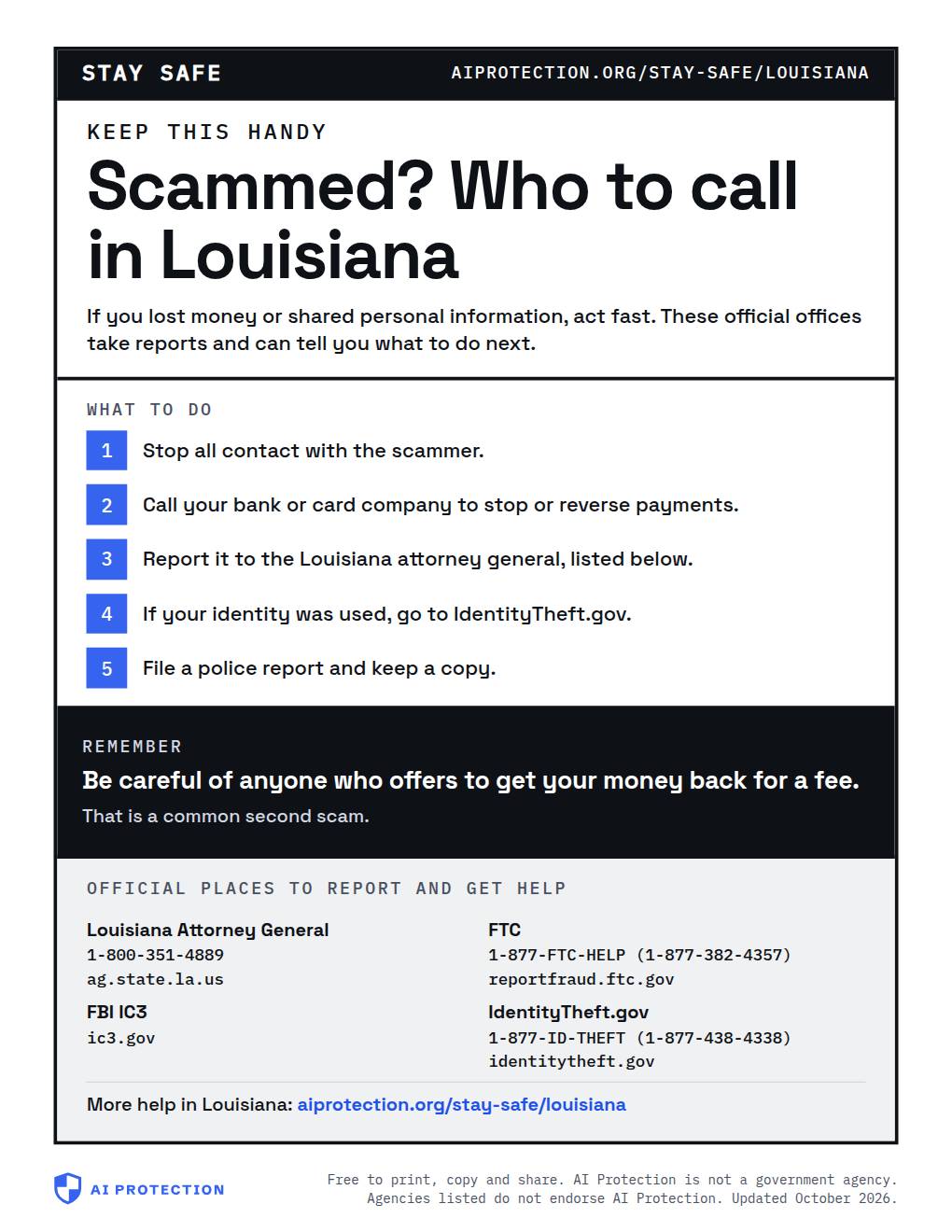
Preview of the “Where to report a scam in Louisiana” poster

Where to report a scam in Louisiana

Who to call in your state after a scam, with the attorney general’s hotline.

Good for: senior centers, libraries, government offices, community centers, clinics, caregivers
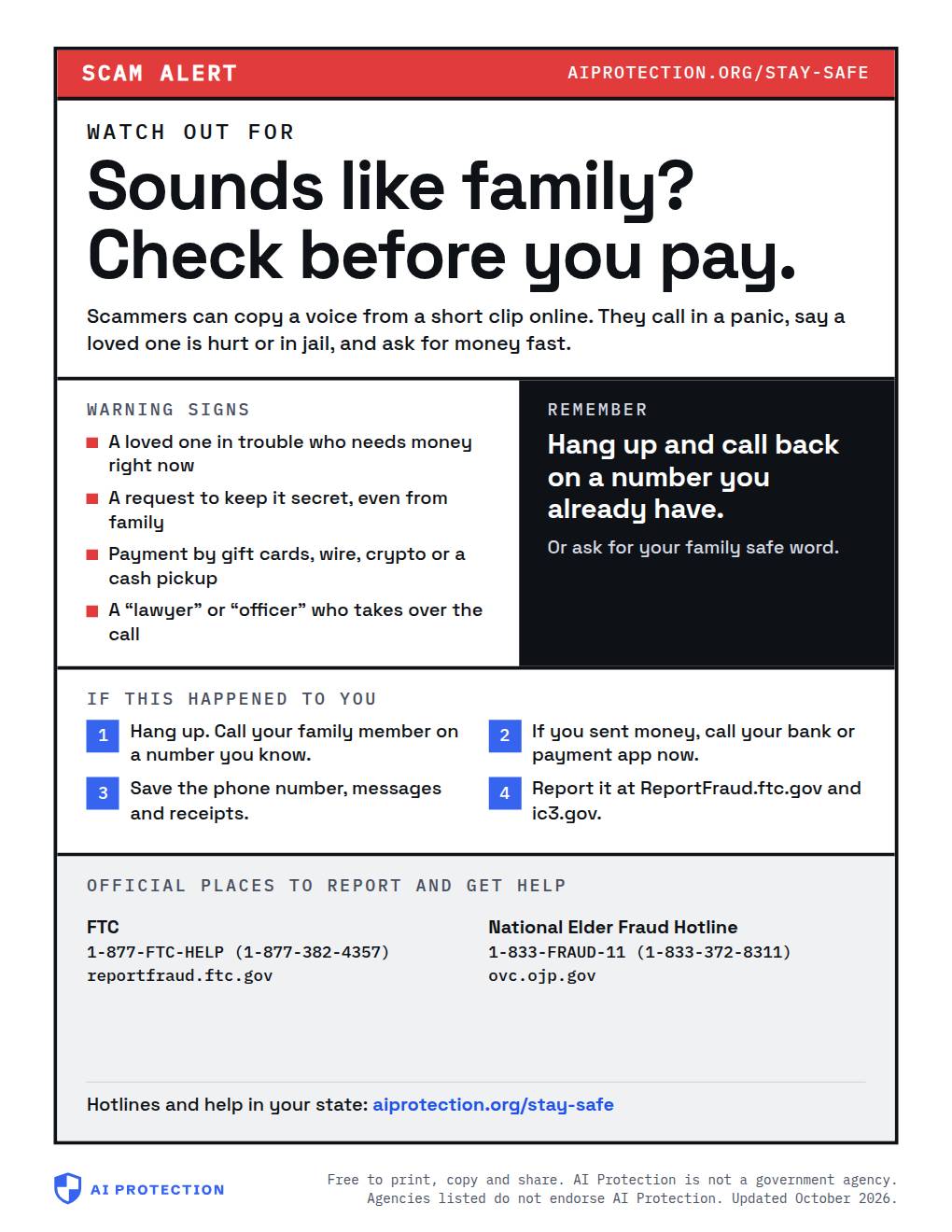
Preview of the “Family emergency call scam” poster

Family emergency call scam

Calls that sound like a family member in trouble: the warning signs and what to do.

Good for: senior centers, libraries, community centers, places of worship, apartment buildings, families
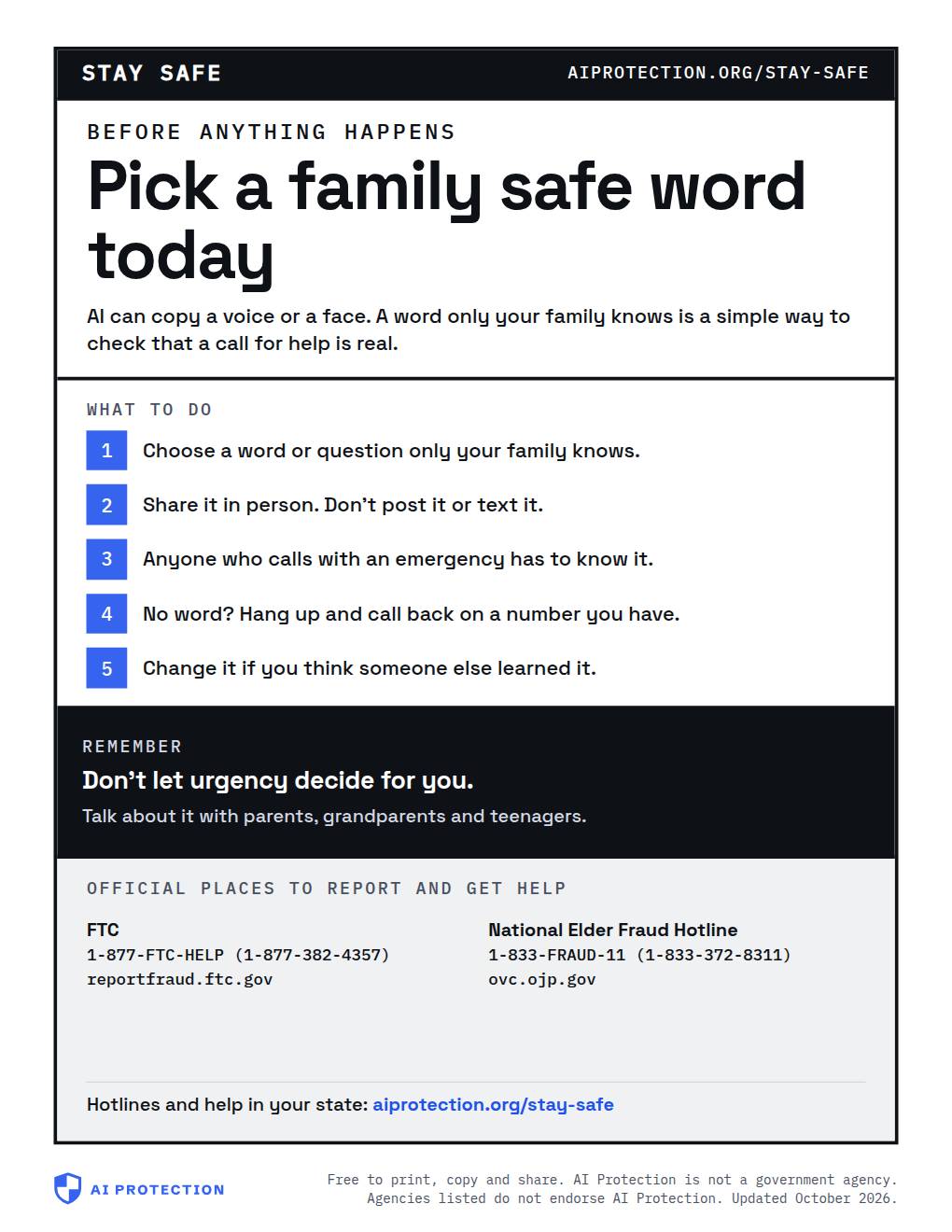
Preview of the “Pick a family safe word” poster

Pick a family safe word

A simple habit for the whole family: a safe word that proves an emergency call is real.

Good for: families, senior centers, schools, libraries, places of worship, caregivers
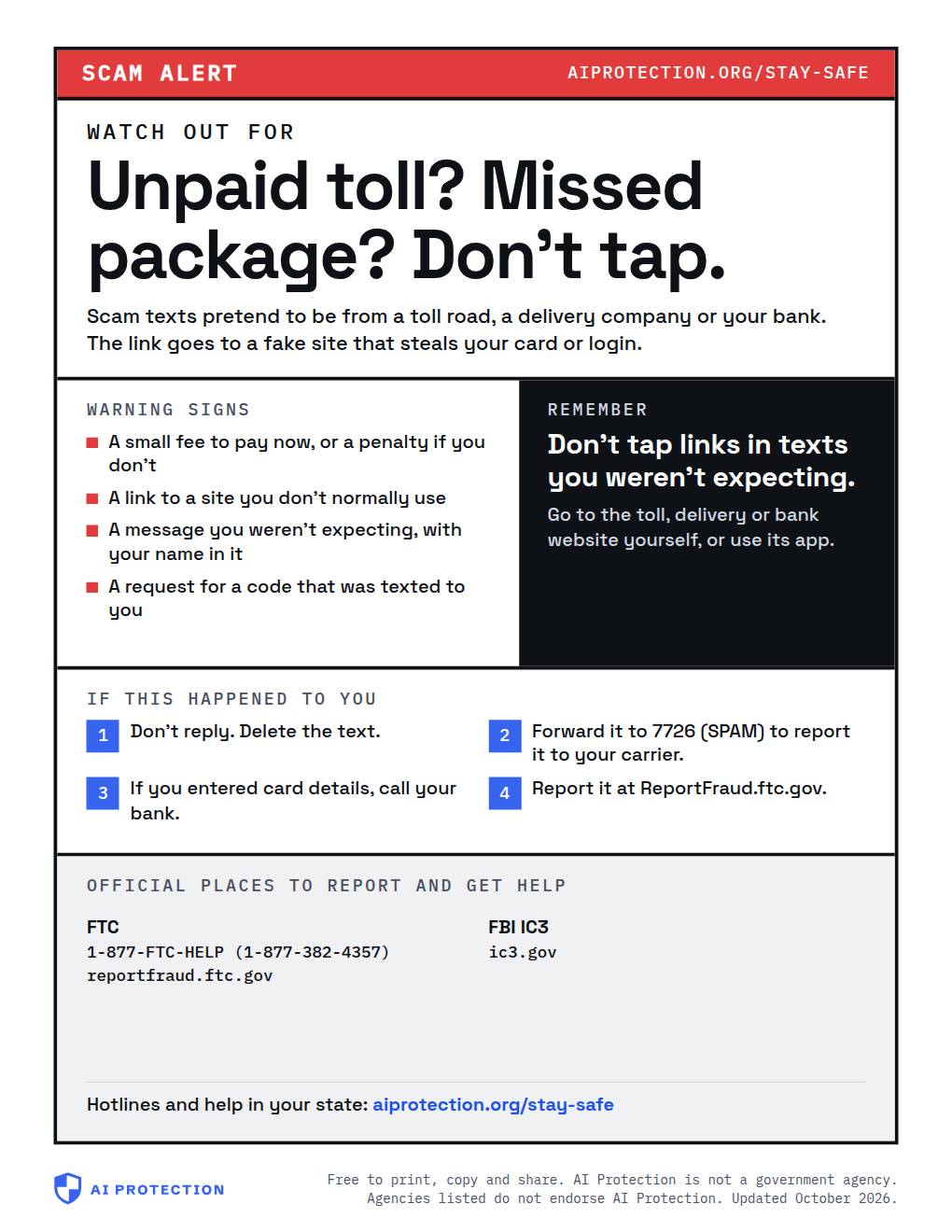
Preview of the “Fake text message scam” poster

Fake text message scam

Fake texts about unpaid tolls, missed deliveries and bank alerts: the warning signs and what to do.

Good for: senior centers, libraries, community centers, places of worship, apartment buildings, families
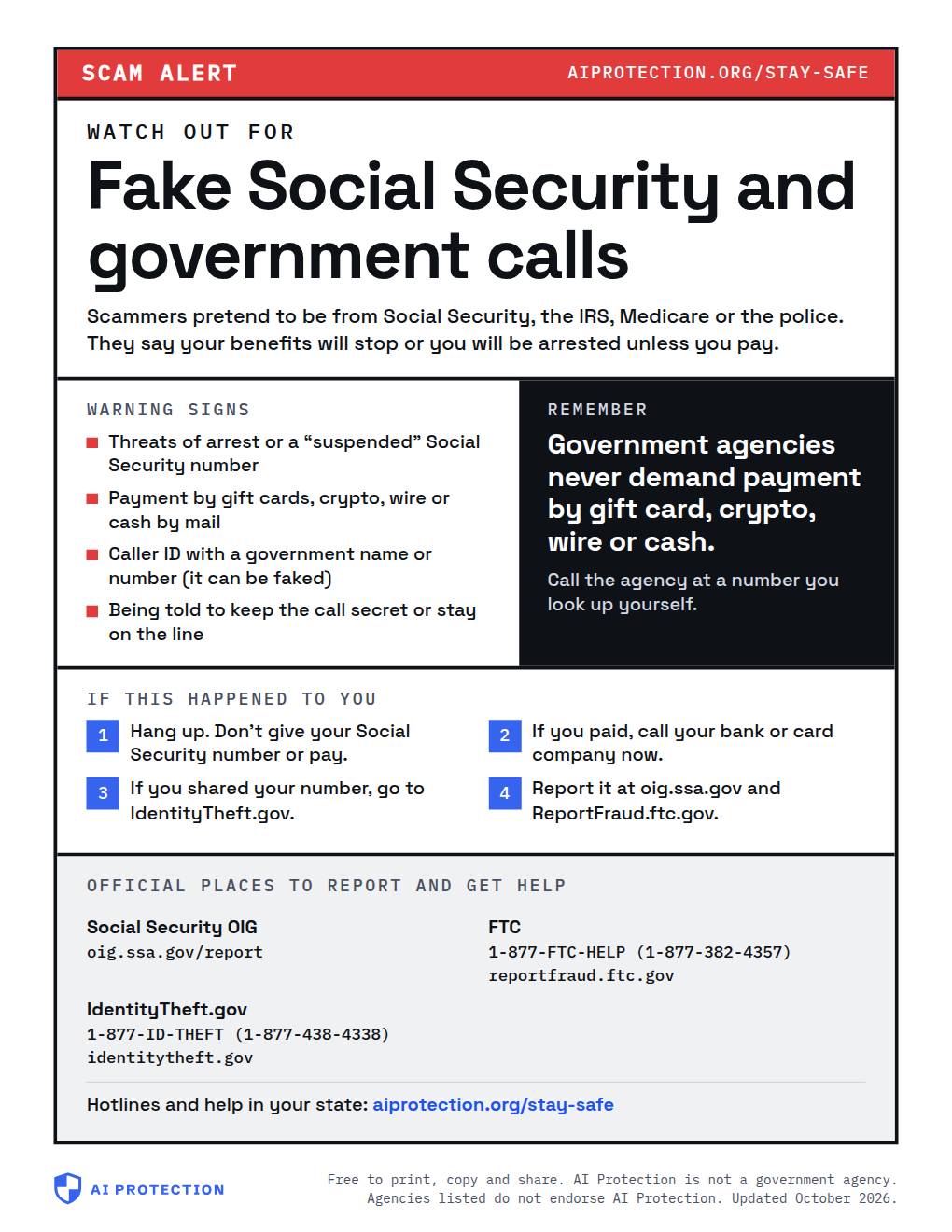
Preview of the “Social Security and government impersonation scam” poster

Social Security and government impersonation scam

Callers who claim to be from Social Security or the police and demand payment.

Good for: senior centers, libraries, government offices, clinics, places of worship
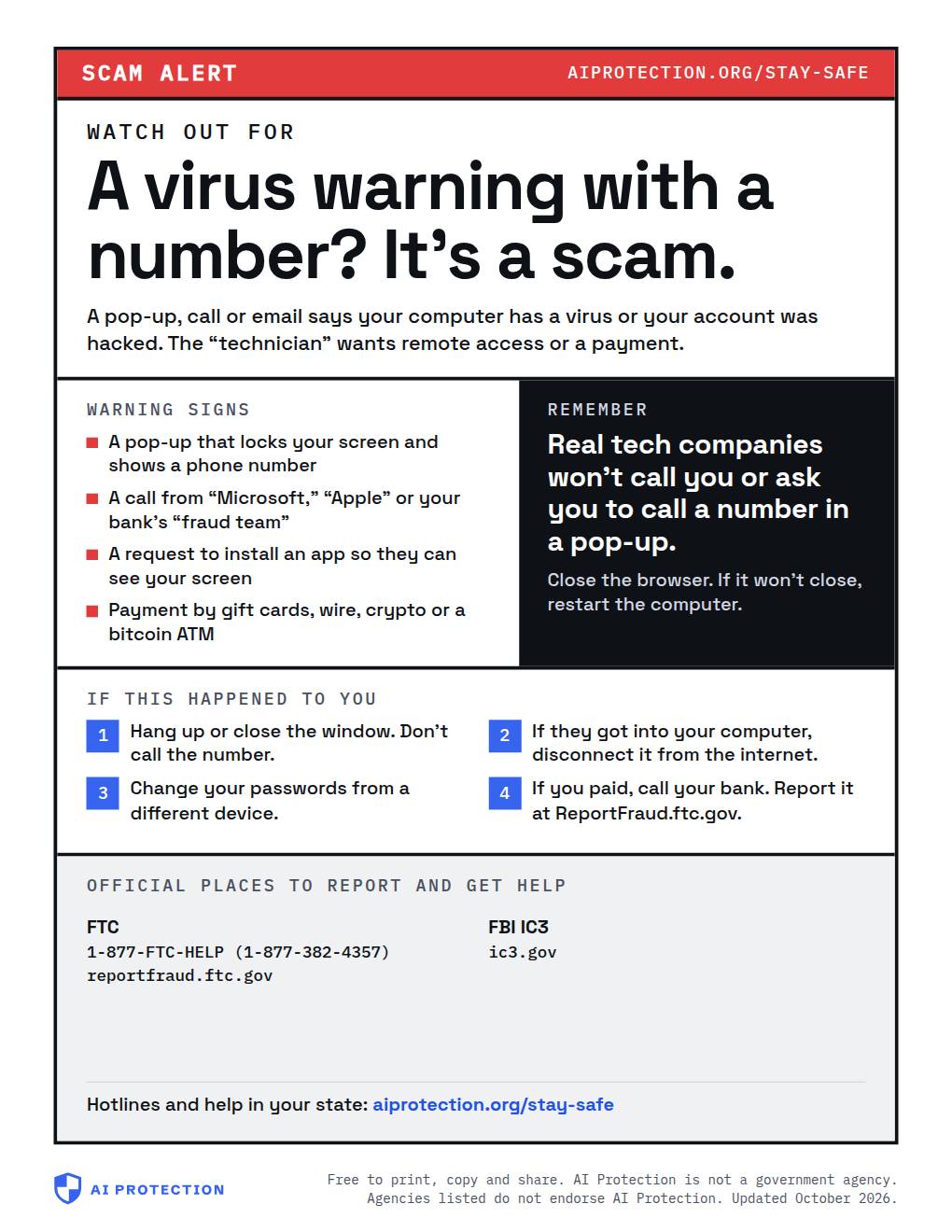
Preview of the “Tech support scam” poster

Tech support scam

Fake virus warnings and “technicians” who want remote access: the warning signs and what to do.

Good for: senior centers, libraries, community centers, places of worship, apartment buildings, families
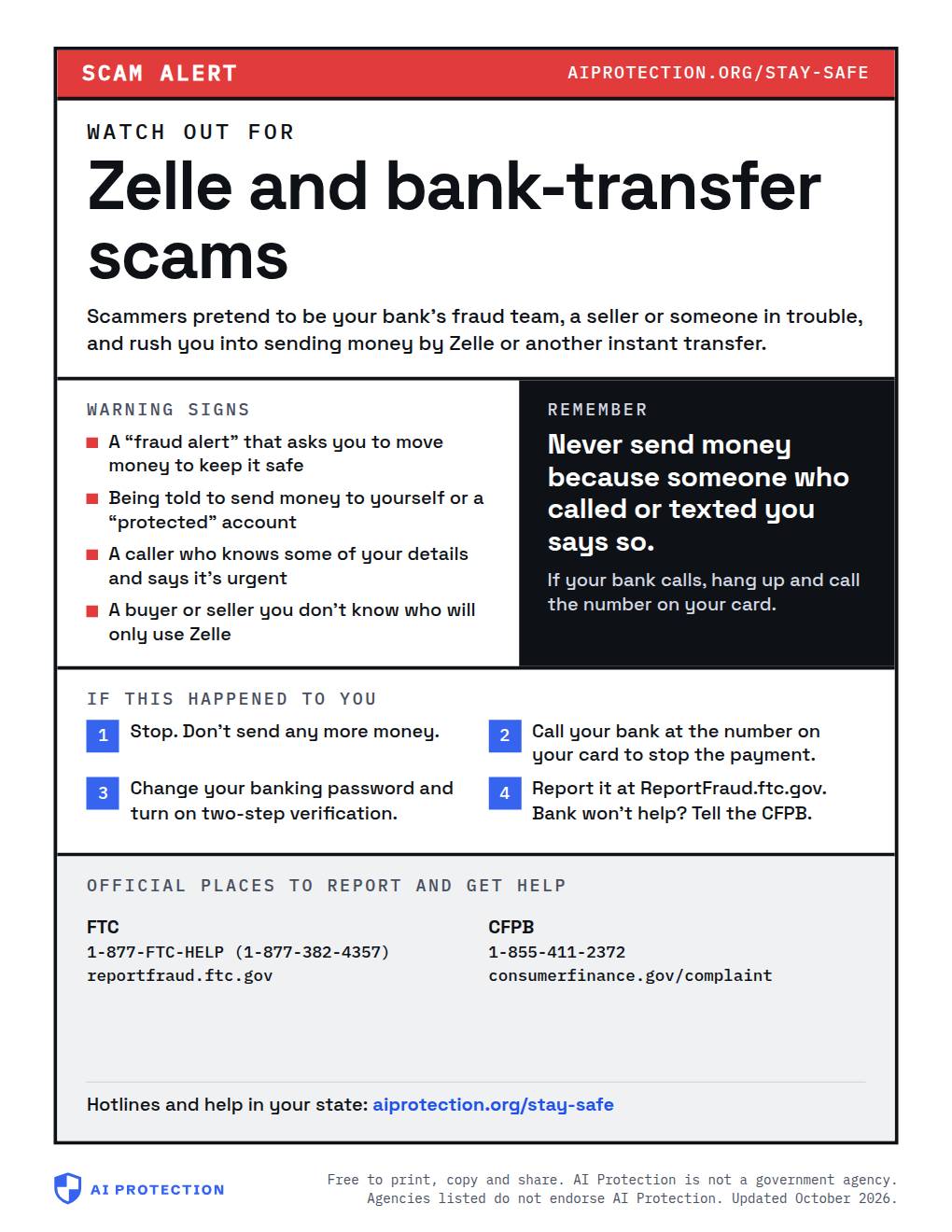
Preview of the “Zelle and bank-transfer scam” poster

Zelle and bank-transfer scam

Fake bank fraud calls that ask you to send money with Zelle or another app.

Good for: senior centers, libraries, community centers, apartment buildings, families
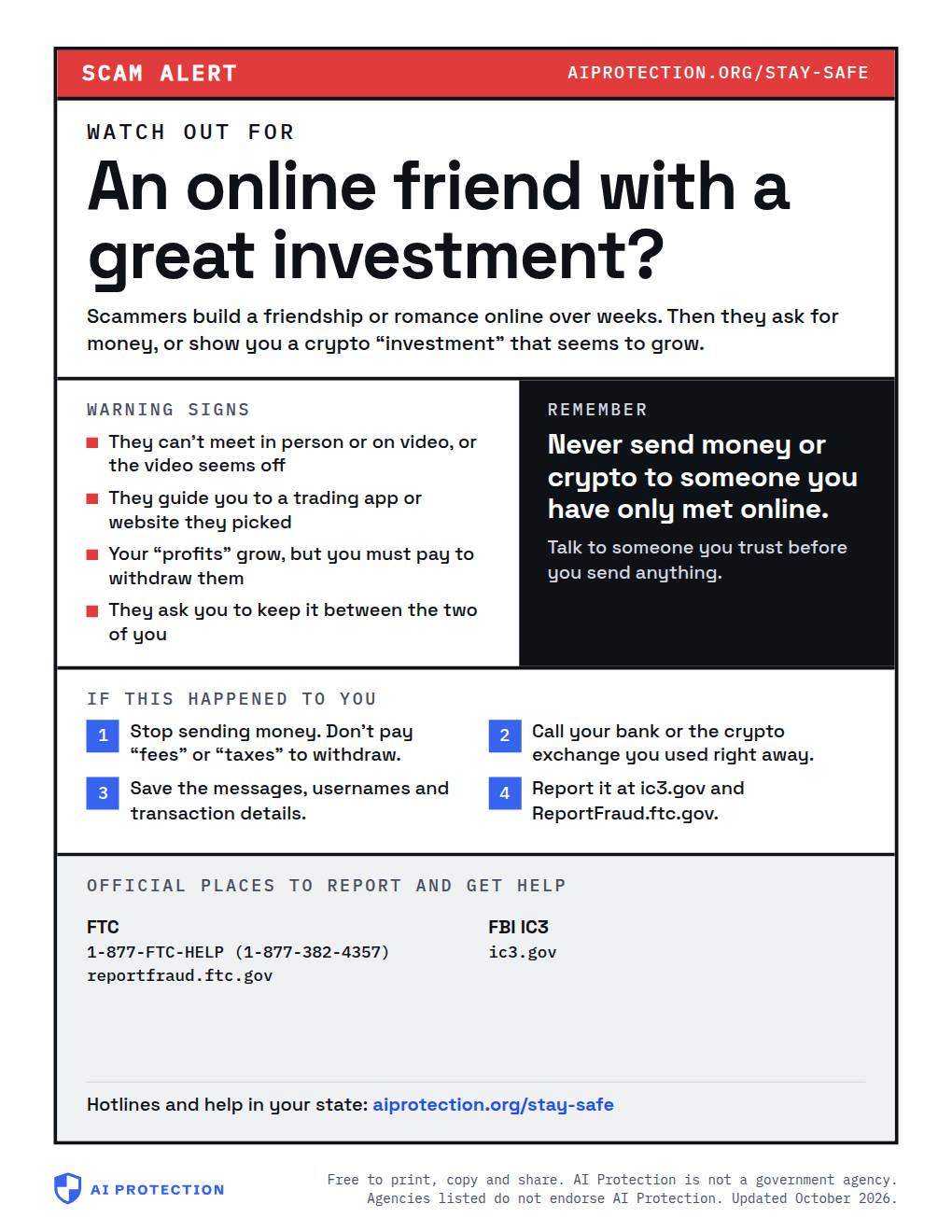
Preview of the “Romance and investment scam” poster

Romance and investment scam

Online friendships that turn into requests for money or crypto “investments”: the warning signs and what to do.

Good for: senior centers, libraries, community centers, places of worship, apartment buildings, families
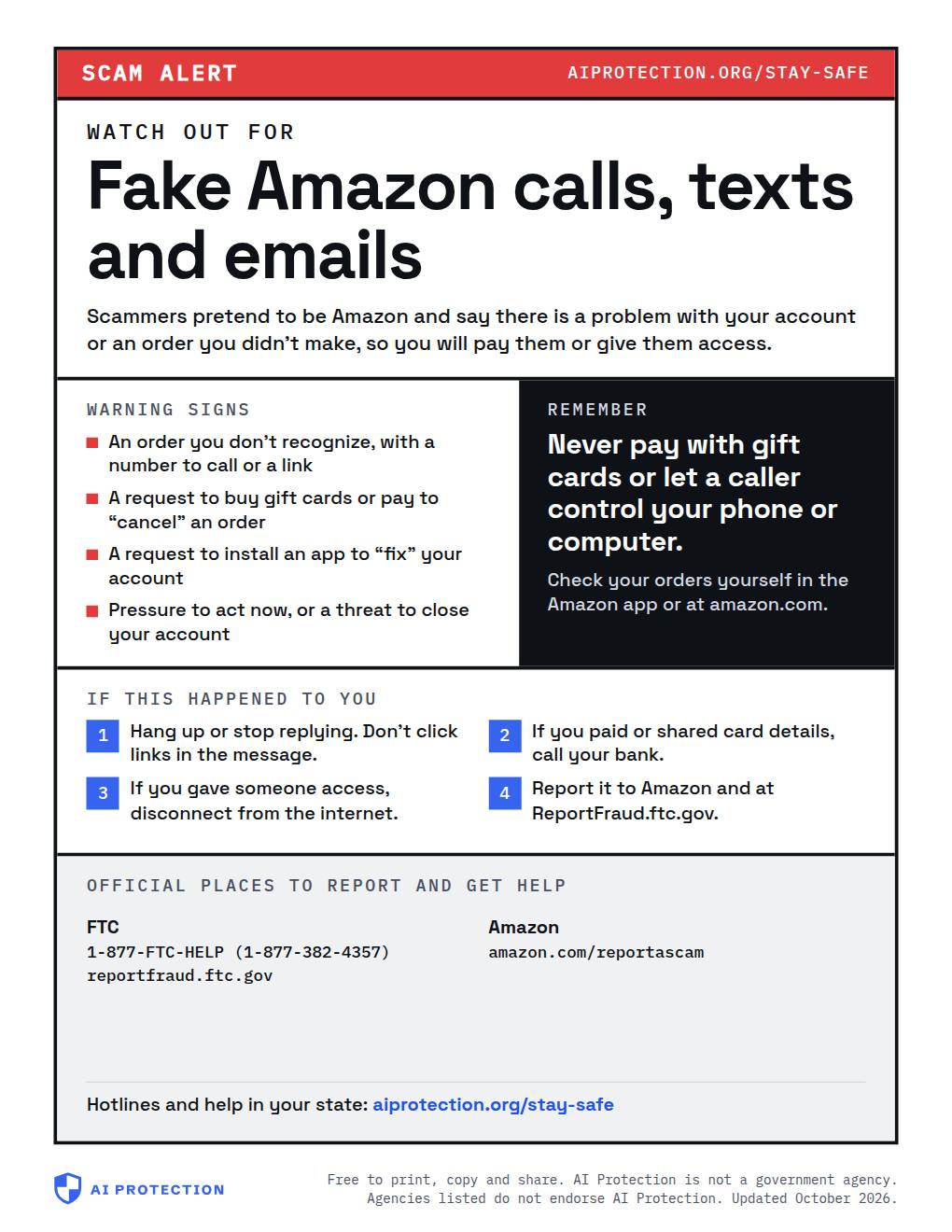
Preview of the “Amazon impersonation scam” poster

Amazon impersonation scam

Fake Amazon calls, texts and emails: the warning signs and what to do.

Good for: senior centers, libraries, community centers, apartment buildings, families

See every poster →

Questions

Questions people ask

Are AI scams happening in Louisiana?

Yes. State reports don’t separate AI scams yet, but the FBI received 22,364 complaints mentioning AI nationwide in 2025, with $893,346,472 in reported losses. In Louisiana, people filed 8,623 internet crime complaints with the FBI that year, 31st in the nation.

How can I tell if a call from a family member is real?

You often can’t tell by the voice alone anymore. AI can copy how someone sounds from a short recording, sometimes called voice cloning. Hang up and call them back on the number you know, or ask your family safe word.

Who do I report an AI scam to in Louisiana?

Report it to the FTC at ReportFraud.ftc.gov, to the FBI at ic3.gov if it happened online or by phone, and to the Louisiana Attorney General at 1-800-351-4889. If your identity was used, go to IdentityTheft.gov. File a local police report too.

Can I get my money back?

Sometimes. Your best chance is to call your bank, card company, gift card company, or crypto exchange right away. Be careful of anyone who contacts you offering to get your money back for a fee. That is a common second scam.

Where does the data on this page come from?

From public government reports: Consumer Sentinel Network Data Book 2024 and 2025 Internet Crime Report. Contact details come from each agency’s own website. We update this page when new reports come out. Sources are listed below.

Anything AI can do for you, it can do to you.

See what AI can find about you.

Scams that sound personal start with personal details. Our free scan checks more than 200 US data-broker and people-search sites, so you can see how much about you is already out there.

Run a free scan

Sources

Page last reviewed October 1, 2026. If a number or link has changed, email support@aiprotection.org.

Sources

Education only, not legal advice. AI Protection is not a government agency and is not affiliated with the FTC, the FBI, or the Louisiana Attorney General.